Making Sense of Mind-Only
Why Yogācāra Buddhism Matters
By William S. Waldron
This survey of the Yogācāra school of Indian Buddhism makes its key texts and ideas accessible and relevant through engaging, contemporary examples. It interprets Yogācāra Buddhism as a coherent system of ideas and practices in relation to the path to liberation.
Mahāyāna Buddhism arose in classical India and flourished in China, Tibet, Korea, Vietnam, and Japan. While one of its major Indian schools, the Middle Way (Madhyamaka) focuses on the concept of emptiness—that all phenomena lack their own essence—the Yoga Practitioners school (Yogācāra) focuses on the cognitive processes whereby we impute such essences. Through everyday examples and analogues in cognitive science, author William Waldron makes Yogācāra’s core teachings—the three turnings of the Dharma-wheel, the three-nature theory, the store-house consciousness, and the idea of mere perception—accessible to a general audience.
Countering the common view of Yogācāra as a form of idealism, Waldron treats Yogācāra Buddhism as a coherent system of ideas and practices on its own terms, with dependent arising its guiding principle. He first examines early Buddhist texts that show how our affective and cognitive processes shape the way objects and worlds appear to us, and how we erroneously grasp onto them as essentially real—perpetuating the engrained habits that bind us to saṃsāra. After analyzing the early Madhyamaka critique of essences, he then examines how Yogācāra texts, such as the Saṃdhinirmocana Sūtra and Stages of Yogic Practice, build upon these earlier ideas to argue that our constructive processes also occur unconsciously. Not only are we collectively, yet mostly unknowingly, constructing our shared realities—our cultural worlds—they are also mediated through the store-house consciousness (ālaya-vijñāna)—functioning as a kind of “cultural unconscious.”
Next, Vasubandhu’s Twenty Verses argues that we can learn to recognize such objects and worlds as “mere perceptions” (vijñāpti-mātra) and thereby abandon our enchantment with the products of our own cognitive processes. The author walks us through the Mahāyāna path to this transformation as gracefully laid out in Maitreya’s Distinguishing Phenomena from their Ultimate Nature. Finally, he considers how Yogācāra perspectives inspire us to rethink religion in our scientific and pluralistic age.
ABOUT THE AUTHOR
Bill Waldron got his Ph.D. from the University of Wisconsin, Madison, in 1990 after extensive travel and study in Asia with native Indian, Tibetan, Chinese, and Japanese scholars and three years of research at Ōtani University in Kyoto, Japan. He has been teaching courses at Middlebury College since 1996 on Indian and Tibetan Buddhism, comparative philosophies of mind, and theory and method in the study of religion. His publications focus on the Yogācāra school of Indian Buddhism in dialogue with modern thought. His first book, The Buddhist Unconscious: The Ālaya-Vijñāna in the Context of Indian Buddhist Thought, was published by RoutledgeCurzon in 2003. He regularly gives talks and workshops at Dharma study groups in America and Asia, focusing on Yogācāra and contemporary topics. When he is not teaching, he may be found wandering the shores of Lake Huron or doing kora with his wife in Kathmandu, Nepal.
Paperback, 384 pges
Product Information
Product Information
Shipping & Returns
Shipping & Returns
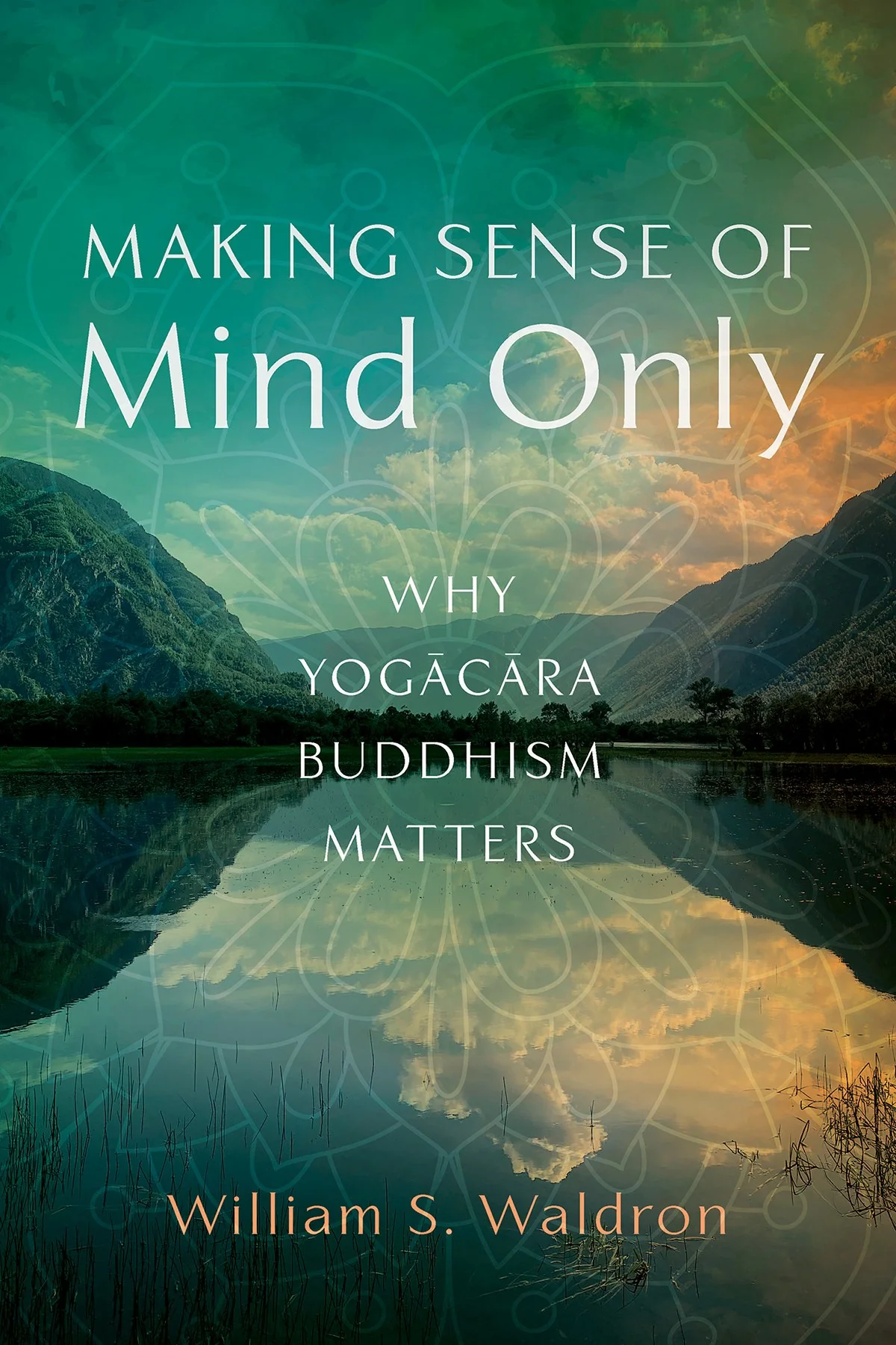

Making Sense of Mind-Only
Making Sense of Mind-Only
Why Yogācāra Buddhism Matters
By William S. Waldron
This survey of the Yogācāra school of Indian Buddhism makes its key texts and ideas accessible and relevant through engaging, contemporary examples. It interprets Yogācāra Buddhism as a coherent system of ideas and practices in relation to the path to liberation.
Mahāyāna Buddhism arose in classical India and flourished in China, Tibet, Korea, Vietnam, and Japan. While one of its major Indian schools, the Middle Way (Madhyamaka) focuses on the concept of emptiness—that all phenomena lack their own essence—the Yoga Practitioners school (Yogācāra) focuses on the cognitive processes whereby we impute such essences. Through everyday examples and analogues in cognitive science, author William Waldron makes Yogācāra’s core teachings—the three turnings of the Dharma-wheel, the three-nature theory, the store-house consciousness, and the idea of mere perception—accessible to a general audience.
Countering the common view of Yogācāra as a form of idealism, Waldron treats Yogācāra Buddhism as a coherent system of ideas and practices on its own terms, with dependent arising its guiding principle. He first examines early Buddhist texts that show how our affective and cognitive processes shape the way objects and worlds appear to us, and how we erroneously grasp onto them as essentially real—perpetuating the engrained habits that bind us to saṃsāra. After analyzing the early Madhyamaka critique of essences, he then examines how Yogācāra texts, such as the Saṃdhinirmocana Sūtra and Stages of Yogic Practice, build upon these earlier ideas to argue that our constructive processes also occur unconsciously. Not only are we collectively, yet mostly unknowingly, constructing our shared realities—our cultural worlds—they are also mediated through the store-house consciousness (ālaya-vijñāna)—functioning as a kind of “cultural unconscious.”
Next, Vasubandhu’s Twenty Verses argues that we can learn to recognize such objects and worlds as “mere perceptions” (vijñāpti-mātra) and thereby abandon our enchantment with the products of our own cognitive processes. The author walks us through the Mahāyāna path to this transformation as gracefully laid out in Maitreya’s Distinguishing Phenomena from their Ultimate Nature. Finally, he considers how Yogācāra perspectives inspire us to rethink religion in our scientific and pluralistic age.
ABOUT THE AUTHOR
Bill Waldron got his Ph.D. from the University of Wisconsin, Madison, in 1990 after extensive travel and study in Asia with native Indian, Tibetan, Chinese, and Japanese scholars and three years of research at Ōtani University in Kyoto, Japan. He has been teaching courses at Middlebury College since 1996 on Indian and Tibetan Buddhism, comparative philosophies of mind, and theory and method in the study of religion. His publications focus on the Yogācāra school of Indian Buddhism in dialogue with modern thought. His first book, The Buddhist Unconscious: The Ālaya-Vijñāna in the Context of Indian Buddhist Thought, was published by RoutledgeCurzon in 2003. He regularly gives talks and workshops at Dharma study groups in America and Asia, focusing on Yogācāra and contemporary topics. When he is not teaching, he may be found wandering the shores of Lake Huron or doing kora with his wife in Kathmandu, Nepal.
Paperback, 384 pges
Product Information
Product Information
Shipping & Returns
Shipping & Returns
Description
Why Yogācāra Buddhism Matters
By William S. Waldron
This survey of the Yogācāra school of Indian Buddhism makes its key texts and ideas accessible and relevant through engaging, contemporary examples. It interprets Yogācāra Buddhism as a coherent system of ideas and practices in relation to the path to liberation.
Mahāyāna Buddhism arose in classical India and flourished in China, Tibet, Korea, Vietnam, and Japan. While one of its major Indian schools, the Middle Way (Madhyamaka) focuses on the concept of emptiness—that all phenomena lack their own essence—the Yoga Practitioners school (Yogācāra) focuses on the cognitive processes whereby we impute such essences. Through everyday examples and analogues in cognitive science, author William Waldron makes Yogācāra’s core teachings—the three turnings of the Dharma-wheel, the three-nature theory, the store-house consciousness, and the idea of mere perception—accessible to a general audience.
Countering the common view of Yogācāra as a form of idealism, Waldron treats Yogācāra Buddhism as a coherent system of ideas and practices on its own terms, with dependent arising its guiding principle. He first examines early Buddhist texts that show how our affective and cognitive processes shape the way objects and worlds appear to us, and how we erroneously grasp onto them as essentially real—perpetuating the engrained habits that bind us to saṃsāra. After analyzing the early Madhyamaka critique of essences, he then examines how Yogācāra texts, such as the Saṃdhinirmocana Sūtra and Stages of Yogic Practice, build upon these earlier ideas to argue that our constructive processes also occur unconsciously. Not only are we collectively, yet mostly unknowingly, constructing our shared realities—our cultural worlds—they are also mediated through the store-house consciousness (ālaya-vijñāna)—functioning as a kind of “cultural unconscious.”
Next, Vasubandhu’s Twenty Verses argues that we can learn to recognize such objects and worlds as “mere perceptions” (vijñāpti-mātra) and thereby abandon our enchantment with the products of our own cognitive processes. The author walks us through the Mahāyāna path to this transformation as gracefully laid out in Maitreya’s Distinguishing Phenomena from their Ultimate Nature. Finally, he considers how Yogācāra perspectives inspire us to rethink religion in our scientific and pluralistic age.
ABOUT THE AUTHOR
Bill Waldron got his Ph.D. from the University of Wisconsin, Madison, in 1990 after extensive travel and study in Asia with native Indian, Tibetan, Chinese, and Japanese scholars and three years of research at Ōtani University in Kyoto, Japan. He has been teaching courses at Middlebury College since 1996 on Indian and Tibetan Buddhism, comparative philosophies of mind, and theory and method in the study of religion. His publications focus on the Yogācāra school of Indian Buddhism in dialogue with modern thought. His first book, The Buddhist Unconscious: The Ālaya-Vijñāna in the Context of Indian Buddhist Thought, was published by RoutledgeCurzon in 2003. He regularly gives talks and workshops at Dharma study groups in America and Asia, focusing on Yogācāra and contemporary topics. When he is not teaching, he may be found wandering the shores of Lake Huron or doing kora with his wife in Kathmandu, Nepal.
Paperback, 384 pges